The problem: stocktaking stops work
In most warehouses a stocktake means a day with the warehouse closed, or staff counting cartons after hours, bay by bay, on paper and then into the system. Because it is expensive it happens once or twice a year, so differences build up in between and nobody knows when they started.
The idea behind Rakaiz Jard: the storekeeper photographs the bay with their phone, the system counts and compares with the system balance, and manual counting is left for the differences only.
The test: real photos, not lab photos
We used real, free-to-use shelf photos from Unsplash, not from our own warehouses: a shelf of water cartons on two levels, a shelving unit with orange packaging boxes on three levels next to a glass window, and a whole aisle in a spare-parts warehouse. We counted the items in each photo by hand to compare with the system, and used Ultralytics' official YOLOE model, which looks for objects from a text description or from an example in the photo itself.
1. An example beats a description
We started with a text description: "find boxes and cartons". On the water shelf the model counted 9 cartons out of 9. But on the middle level of the orange shelf, with 14 identical boxes packed together, it counted only 12, because touching boxes sometimes look like one block.
Then we tried a second way: we mark one box in the photo as an example, and the model looks for everything similar. It counted the middle level 14 out of 14 with no errors, and the water shelf stayed correct. This fits stocktaking well, because a bay usually holds one product, and the example is marked once per product and saved.
2. Glass creates phantom cartons
Next to the orange shelf is a glass window that reflects the boxes. The model counted five reflections as boxes. The fix is simple: each bay has a frame set once during setup, and only what is inside it is counted. The reflections disappeared, along with any carton from a neighbouring shelf showing at the edge of the photo.
3. Levels from the shelf boards, not guesswork
We wanted to compare each level separately, so we tried grouping items by their height in the photo. On the top shelf, one box standing and one lying down made the level look like two. So we now mark the shelf board positions once per bay, and the count is split cleanly by level.
4. A photo only counts what it sees
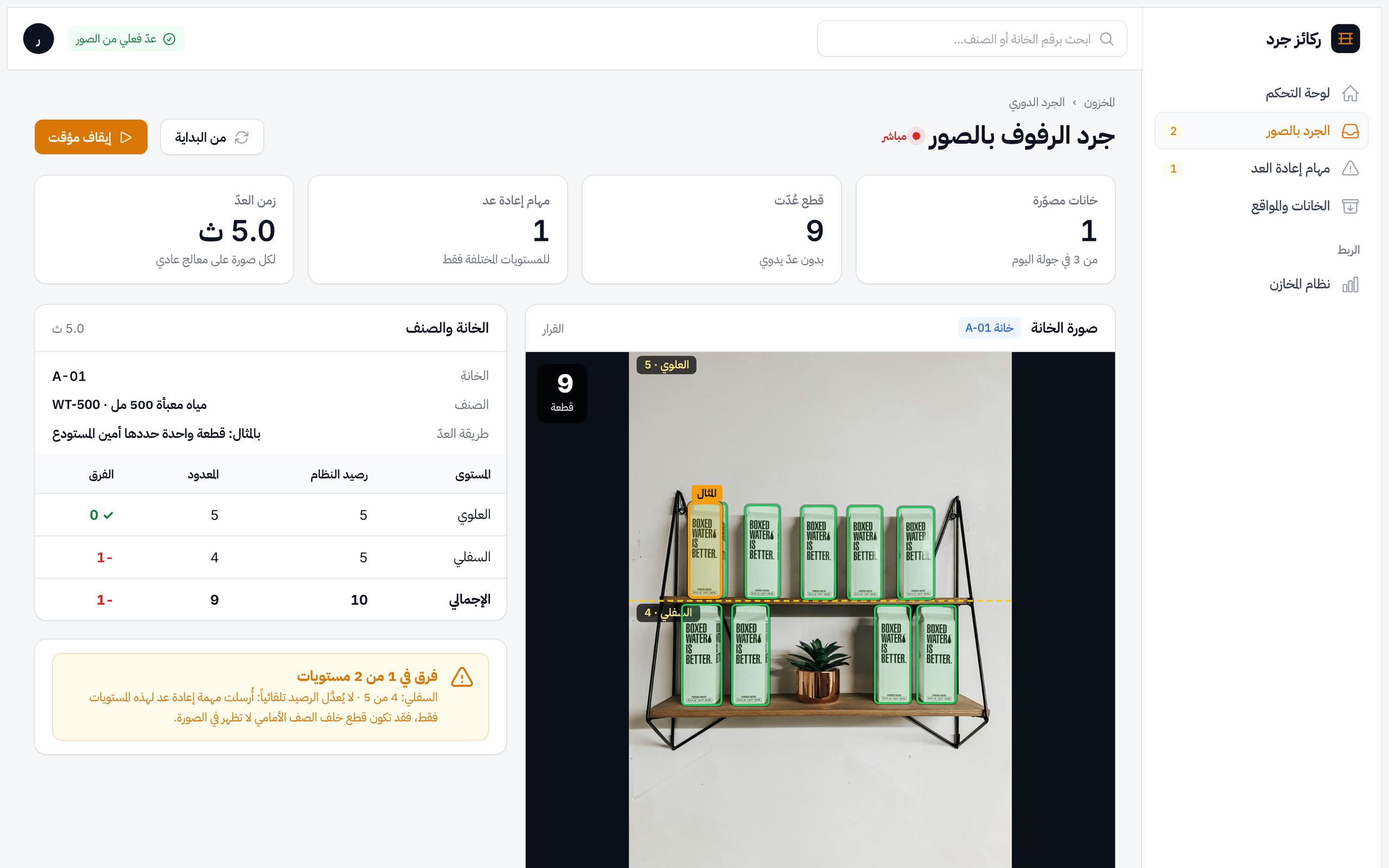
This is the most important lesson. The bottom level holds 9 boxes, but a back row hides behind the front row, so the system counted 5. On the top level it counted 4 of 5 because a small box is almost hidden. If the system changed the balance from the photo, it would record a shortage that does not exist.
So Rakaiz Jard never changes the balance. Any difference becomes a recount task for that level only. In this photo: two tasks for two levels, instead of counting the whole unit or the whole warehouse. The matching middle level is closed straight away.
On the water shelf we set a demo balance of 10 cartons, and the photo showed 9 because a plant pot takes the place of a carton on the bottom level. That is a real difference, and the system sent a task for the bottom level only.
5. A whole-aisle photo is an estimate
We tried a photo of a whole aisle in a spare-parts warehouse. 66 cartons showed up across four levels, but the distant cartons are small and packed together, and even we cannot count them precisely from the photo. So the system shows the number as an estimate, does not accept it, and asks for each bay to be photographed separately.
We also tried two model sizes: the large one found more cartons in crowded photos but was about three times slower in automatic mode. Example mode with the large model counts a bay in about 4 seconds on an ordinary processor, and that is what we chose.
What we learned
- An example beats a description: one item marked by the storekeeper raises accuracy on packed shelves
- Set up once: the bay frame, shelf boards and example are saved, and later rounds are just photos
- Don't change the balance from a photo: the photo narrows manual counting down to the differences; it does not replace it
- One photo per bay: a wide photo is an estimate; a close one is a count
Want stocktaking without closing?
See Rakaiz Jard, the Warehouse & Procurement System it works with, or get in touch and we will try the system on photos of your warehouse shelves.